
 Even before Weixiao Huang received his doctorate from Rensselaer Polytechnic Institute, his new transistor captured the attention of some of the biggest American and Japanese automobile companies. The 2008 graduate's invention could replace one of the most common pieces of technology in the world--the silicon transistor for high-power and high-temperature electronics.
DIRECTLY TO
 |  |  |  |
YOUTHSPROUTS

Today and Tomorrow is Ours
Friday, June 06, 2008
Weixiao Haung and new GAN transistor.
Saturday, April 12, 2008
Live-animal nerve regeneration study gets a boost

Figure illustrates "lab on a chip" technique developed by MIT researchers to allow immobilization and imaging of a live C. elegans worm: (a-i) worm moves freely in chip's microfluidic channel; (a-ii) partial immobilization of worm; (a-iii) full immobilization; (b) low magnification image of worm immobilized in the device; (c) close-up of immobilized worm showing animal's neurons (fluorescent). Image courtesy / Mehmet Fatih Yanik
The team has found a unique way to immobilize the animals while they are still awake for several minutes with unprecedented stability, which then allowed the researchers to conduct fast, detailed three-dimensional imaging and to perform high-resolution laser nanosurgery on the animals.
The advance, which builds on a technology first reported last year, could ultimately help researchers better understand the genetic underpinnings of regeneration and degeneration in the nervous system--not just in the worm but in more complex organisms including humans. That, in turn, could help in treatments of neural injuries and diseases such as Parkinson's and Alzheimer's.
Led by Mehmet Fatih Yanik, MIT assistant professor of electrical engineering and computer science, the team reported its latest work in the April 2 advanced online issue of the journal Lab on a Chip. The work involves the C. elegans worm, one of the tiniest multi-cellular organisms known. Smaller than a human hair, the worm is considered a key model for investigating a variety of biological phenomena such as aging, fat metabolism and neurological diseases.
Geneticists have been studying C. elegans since the 1960s, but the manual processes they used to do so were painstaking and time-consuming. That changed in a big way last year when Yanik and colleagues reported in the Proceedings of the National Academy of Science that they had developed a microfluidic chip to automate and accelerate research on the tiny worms. Essentially, the tiny worms are flowed inside the chip, immobilized by suction and imaged with a high-resolution microscope
__
Flying off course: Why migratory birds from Asia land in Europe

The new research findings also now explain why the only vagrants to have been seen by bird-spotters in Central Europe are long-distance migratory birds from Far East Asia. The genetically programmed journey for short-distance migratory birds from Asia would end somewhere in the west of northern Asia. Credit: Deutsches Zentrum fur Luft- und Raumfahrt (DLR) / modified from Susan Walter/UFZ
The scientists assessed several thousand reports of Asian birds from the leaf-warbler and thrush families that had strayed to Europe. They discovered that the distance between the breeding grounds in northern Siberia and the wintering sites in southern Asia was often similar to the distance between the breeding grounds and Europe. The more similar the distances and the more numerous a particular species, the higher the probability of this species of bird straying to Europe
__
EarthFX
www.youthsprouts.blogspot.com
The EarthFX Earth Science Data Model (EESDM) is the result of years of being applied to a wide variety of real studies where the storage of environmental data is a key component. This Data Model is the tables, fields and relationships that make up a database and is fundamental to both effective analysis and having the data outlive the end of the project. Database


For more information use the menu on the left or click here.
SiteFX
SiteFX assists users to organize and manage their environmental data. SiteFX strengths are the managment of groundwater and water-quality data and all data is stored in a relational database.
 |  |  |
For more information, use the menu on the left or click here.
VIEWLOG
VIEWLOG provides a truly integrated borehole data management and interpretation system. By tightly coupling a powerful borehole data editor with GIS-style mapping and cross-section tools, VIEWLOG offers an unrivalled level of visual interpretation control.
 |  |  |
For more information, use the menu on the left or click here.
EarthFX Data Centre
The EarthFX Data Centre pulls all of our software products together in an enterprise solution. In addition to remote SiteFX access, major web based modules include the Lab Integration, Sampling Program Admin, Temporal Data Graphing and Viewlog Mapping modules.
 |  |  |
For more information use the menu on the left, or click here.
About EarthFX
EarthFX is a recognized power in the management of groundwater data, and the firm delivers data-management solutions to streamline the collection, management, analysis and reporting of these data. This is acheived with proven data models, on-site training and capacity building, software and support.
The firm is staffed with geologists, hydrogeologists, engineers, and computer scientists, and collectively, we offer modelling, programming, database and web technology solutions specifically for the geosciences.
Our Approach
At the foundation of our approach is comprehensive data management. Data is compiled into an open database in MS-ACCESS. The data is stored in our EarthFX Data Model, and our analysis and visualization methods as well as our software are fully linked to this database.
Our software allows for detailed visualization of the borehole data. This includes 2D plan-views and cross sections, and 3D fence diagrams and fly throughs.
Analysis of the data includes the ability to create a detailed 3D geologic model that is linked to the borehole data. Our software allows users to make geologic picks on cross section, delineate bedrock valleys and interpolate geologic surfaces (using advanced geostatistical methods).
Once data has been compiled, visualized and analyzed, a numerical model can be set up. These models can be simple or complex, depending on the needs of the client. We have experience in developing regional-scale, transient models that include groundwater/surface water interaction. We also have the ability to determine detailed water budgets for watersheds.
__First animal on Earth 'more complex than thought'

The evolutionary history of the comb jelly has revealed surprising clues about Earth's first animal. Credit: Casey Dunn
New York (PTI): The first animal on Earth, a mysterious creature whose characteristics can only be inferred from fossils, was probably more complex than earlier thought, a new study has revealed. Using high-powered technologies, researchers in the United States have defined the earliest splits at the base of the animal tree of life -- a hierarchical representation of the evolutionary relationships between species, introduced by Charles Darwin.
According to the study, the comb jelly split off from other animals and diverged onto its own evolutionary path before the sponge, a finding that challenges the traditional view of the base of the tree of life. "This was a complete shocker. So shocking that we initially thought something had gone very wrong. The presence of the relatively complex comb jelly at the base of the tree of life suggests that the first animal was probably more complex than believed," lead researcher Casey Dunn said.
According to her, the comb jelly could have achieved its apparent seniority over the simpler sponge via one of two new evolutionary scenarios -- either it evolved its complexity independently of other animals, after it branched off onto its own evolutionary path or the sponge evolved its simple form from more complex creatures.
"The second scenario is a possibility that underscores the fact that evolution isn't necessarily just a march towards increased complexity. This scenario would provide a dramatic example of that principle," Dunn said.
__Monday, April 07, 2008
Hydrogen-powered plane takes off
The hydrogen-powered plane in action
The first manned, hydrogen-powered plane has been successfully tested in the skies above Spain, its makers say.
The small, propeller-driven craft, developed by aviation giant Boeing, made three short flights at an airfield south of Madrid, the company said.
It was powered by hydrogen fuel cells, which produce only heat and water as exhaust products.
The tests could pave the way for a new generation of greener aircraft, the company said.
Boeing's chief technology officer John Tracy said the flights were "a historical technological success" and "full of promises for a greener future".
Small future
Three test flights of the two-seater aircraft took place in February and March at an airfield at Ocana, south of Madrid. The plane was modified to include a hybrid battery and fuel cell system developed by UK firm Intelligent Energy.
The fuel cells, which create electricity by combining oxygen and hydrogen, were used to power an electric motor coupled to a propeller.
 Other organisations have demonstrated solar-powered planes |
During take-off the plane's batteries were used to provide an additional boost, but whilst in the air, the plane relied entirely on the cells.
Boeing said the plane has a flying time of 45 minutes but tests were limited to around half that time.
Although the test had been successful, the firm said it did not believe fuel cells could be the primary power source for large passenger aircraft.
However, it could be used as a secondary source of energy for large planes, according to Nieves Lapena, the engineer responsible for the test flights, but this may take some time to develop.
"In my opinion, we are talking about a delay of about twenty years," she said.
__Thursday, March 27, 2008
Art cars, Future cars, Technology cars, Muscile cars and more
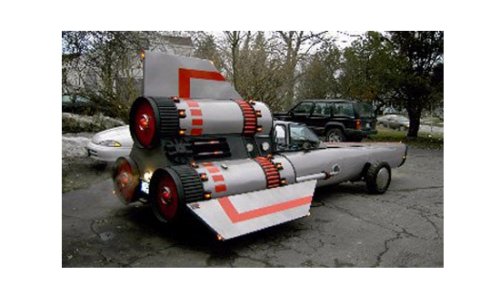 We thought we’d take a little break from the usual and take a look at some cool art cars that geeks have modded into their own visions of coolness. So here’s some random pimped out tonnage of pure nerd love coming at ya. When a nerd has a car, all things are possible…Though it will usually end up having something to do with the Star Wars universe.
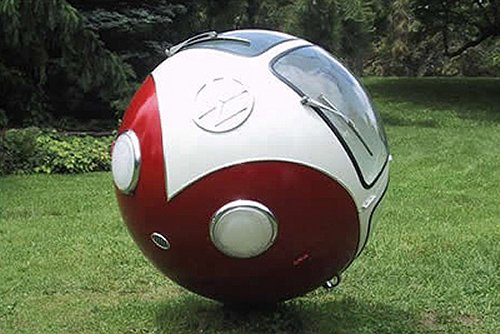
VW Microbus Ball-A piece of art by Billy Gibbons of ZZ Top fame. He took a vw microbus and made it into a VW ball. Truly a thing of beauty. The tires unfold when you need em. This is what we need to see more of on the road. Or in the sky for that matter.
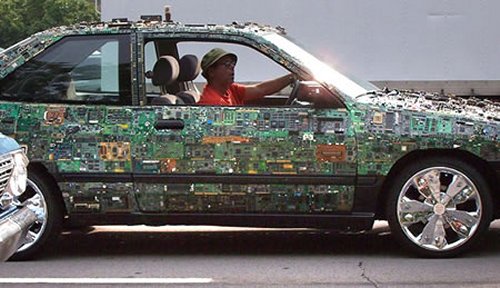
Circuit Board Car-Someone went a little crazy with circuit boards. This one must be blinding in direct sunlight. You have to wonder how much weight the boards added to the car in total.
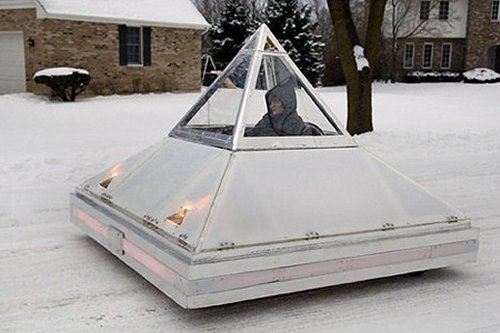
The Pyramid Car-This pyramid electric car weighs 8,000-pounds and is powered by 80-batteries, with four engines. It can supposedly reach speeds of up to 45mph. I love how the canopy pops open like a Colonial Viper from Battlestar Galactica. It was built by a Father and his two sons.
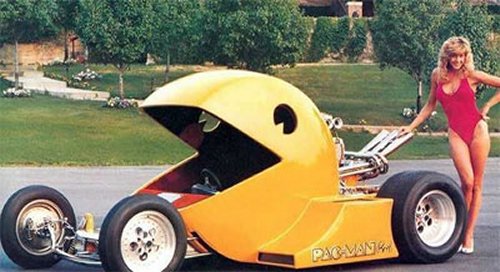
The Pac-Man car-This is the best way to outrun ghosts that I have seen yet. And it attracts the ladies.
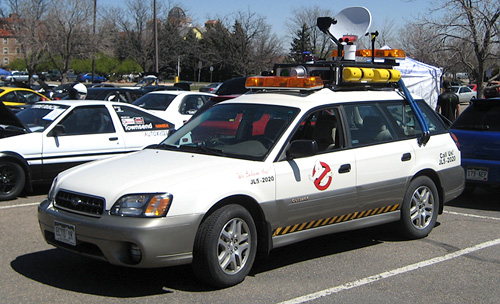
The Subaru Outback Ecto-1-This guy started a thread on the NASIOC forums (North American Subaru Impreza Owners Club) to showcase his 2003 Subaru Outback which he’s converted into a slightly smaller version of the Ecto-1 from the Ghostbusters films.
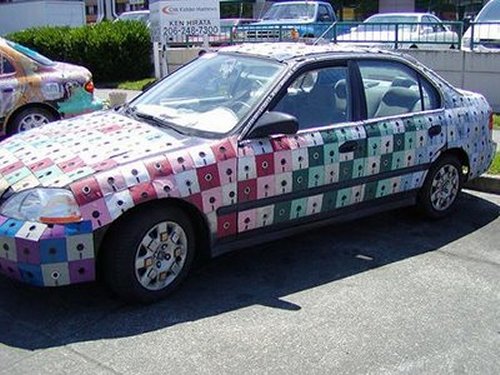
The Floppy Disk car-A 1998 Honda Civic covered with computer keys and, of course, floppy disks.
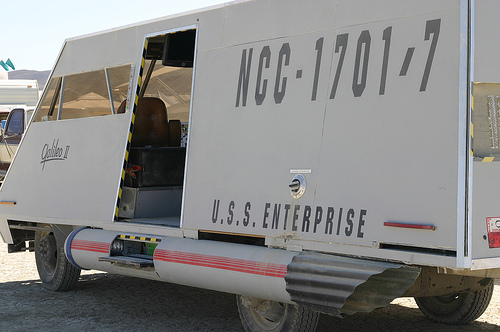
U.S.S. Enterprise NCC-1701-7 Shuttlecar-Now this is truly a geek ride. The only thing that could make it better is if they sold Ice cream from the back of this thing.
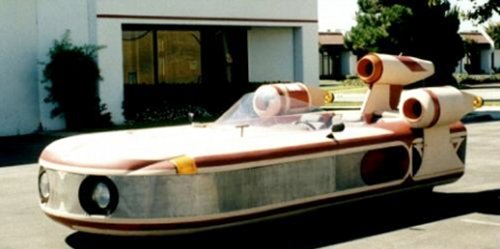
Star Wars Landspeeder-You probably remember this one from a while back. The vehicle was actually licensed in California. It just needs a few droids and your Uncle dressed as Ben Kenobi.
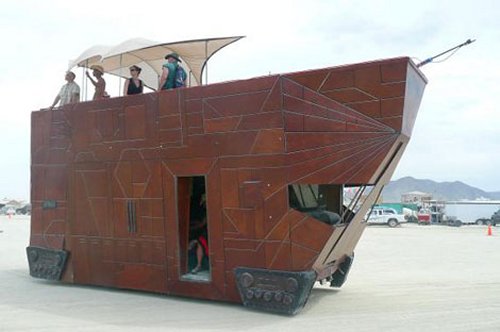
Jawa Sandcrawler-I had no idea that Jawas attended Burning Man. I hope they collected enough robot parts to really stick it to the Skywalkers this season.
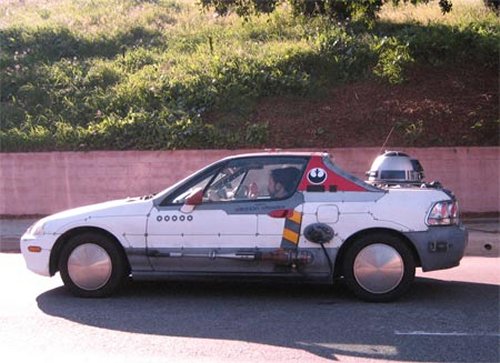
The X-Wing…car-A California guy modded his Honda del Sol into Luke’s X-Wing Fighter. It even has R2 astromech droid in the rear, some burns, and the Rebel insignia, and laser blasters on the car doors.
Battlestar Galactica Viper-Dean Shorey built this car, based on the Vipers from classic Battlestar Galactica, by hand. I would love to see this thing coming down the street.
__
WATER FULE. A GREAT INNOVATION USE WATER TO GENERATE ELECTRICITY, RUN YOUR CAR AND DO MORE
www.youthsprouts.blogspot.com
COMPLETE THEATRY AND INTERVIEW ITS REAL
Water prices are already high though. And water is already trying to be conserved. But if he said only 4oz of water per 100 miles that is absolutely outstanding. 4oz is about the average mouthful of water. All america needs is competition against gas to make OPEC reduce their prices. OPEC is pretty much a modern day monopoly.
__
AVOID DEATH:::::Aubrey de Grey: Why we age and how we can avoid it.
www.youthsprouts.blogspot.com
HE IS EXPLAINING SOMETHING LIKE, LIVE FOR ABOUT HUNDREDS OF YEARS FROM NOW.
IS THIS POSSIBLE. WATCH IT FOR WAKAW.
__
Wednesday, March 26, 2008
Sunday, March 23, 2008
Clothes That Clean Themselves
www.youthsprouts.blogspot.com
Australian researchers are developing a process that could lead to self-cleaning wool sweaters and silk ties.
 Wine be gone: Wool fibers have to be chemically modified to receive a stable coating of titanium dioxide nanocrystals, which break down organic matter in sunlight. Red-wine stains do not leave uncoated fibers even after 20 hours (top right); unmodified nanocrystal-coated fibers show some stains (middle right). The stain is almost gone in chemically modified fibers because of the firmly attached nanocrystals (bottom right).
Credit: American Chemical Society
Wine be gone: Wool fibers have to be chemically modified to receive a stable coating of titanium dioxide nanocrystals, which break down organic matter in sunlight. Red-wine stains do not leave uncoated fibers even after 20 hours (top right); unmodified nanocrystal-coated fibers show some stains (middle right). The stain is almost gone in chemically modified fibers because of the firmly attached nanocrystals (bottom right).
Credit: American Chemical Society
Researchers at Monash University, in Victoria, Australia, have found a way to coat fibers with titanium dioxide nanocrystals, which break down food and dirt in sunlight. The researchers, led by organic chemist and nanomaterials researcher Walid Daoud, have made natural fibers such as wool, silk, and hemp that will automatically remove food, grime, and even red-wine stains when exposed to sunlight.
Daoud and his colleagues coat the fibers with a thin, invisible layer of titanium dioxide nanoparticles. Titanium dioxide, which is used in sunscreens, toothpaste, and paint, is a strong photocatalyst: in the presence of ultraviolet light and water vapor, it forms hydroxyl radicals, which oxidize, or decompose, organic matter. However, says Daoud, "these nanocrystals cannot decompose wool and are harmless to skin." Moreover, the coating does not change the look and feel of the fabric.
To make self-cleaning wool, Daoud and his colleagues use nanocrystals of titanium dioxide that are four to five nanometers in size. In the past, the researchers have made self-cleaning cotton by coating it with these nanocrystals. But coating wool, silk, and hemp has proved more difficult. These fibers are made of a protein called keratin, which does not have any reactive chemical groups on its surface to bind with titanium dioxide. __Cell phone into microscope. -- A Mobile microscopy
 www.youthsprouts.blogspot.com
Researchers at the University of California, Berkeley, have developed a modular, high-magnification microscope attachment for cell phones. The device will enable health workers in remote, rural areas to take high-resolution images of a patient's blood cells using a cell-phone camera, and then transmit the photos to experts at medical centers.
Mobile microscopy: A cell phone incorporating a microscope (top) developed at the University of California, Berkeley, can capture and transmit pictures such as this 23x-magnification image of the freshwater crustacean Cyclops (bottom). Researchers hope that the device will allow patients in remote areas to send images of red blood cells and other diagnostic information to medical specialists.
Credit: David Breslauer
__
www.youthsprouts.blogspot.com
Researchers at the University of California, Berkeley, have developed a modular, high-magnification microscope attachment for cell phones. The device will enable health workers in remote, rural areas to take high-resolution images of a patient's blood cells using a cell-phone camera, and then transmit the photos to experts at medical centers.
Mobile microscopy: A cell phone incorporating a microscope (top) developed at the University of California, Berkeley, can capture and transmit pictures such as this 23x-magnification image of the freshwater crustacean Cyclops (bottom). Researchers hope that the device will allow patients in remote areas to send images of red blood cells and other diagnostic information to medical specialists.
Credit: David Breslauer
__
The Networked Pill----A new information system records what pills do to the body

A system that monitors pill taking and its effects is being engineered by a Silicon Valley startup. The technology consists of pills that report when they've been taken, and sensors that monitor the body's responses.
The company behind the technology, Proteus Biomedical, of Redwood City, CA, calls its technology the Raisin system. George Savage, Proteus's cofounder and a former ER physician, says that the company was motivated by the fact that so many medical problems stem from drug compliance problems. According to Savage, 40 percent of hospital readmissions for heart failure happen because patients fail to take their medications properly.
Even when a regimen is followed, it may not be the best regimen. According to Leslie Saxon, a cardiologist at the University of Southern California, who works as a consultant for Proteus, the dosages of drugs used for heart failure are derived from large clinical trials and may not meet a particular patient's needs. "Imagine a situation where drug ingestion is tracked, and heart pressure before, immediately after, and later are known," says Saxon. "That represents real, individualized, tailored drug therapy."
__Wednesday, March 19, 2008
When you're an anaconda, snakes are dangerious and loving
www.youthsprouts.blogspot.com
_When you're an anaconda you don't need venom to take down your prey, even if its the world's largest rodent, a capybara, weighing somewhere in the neighboorhood of one hundred pounds!_
Tuesday, March 18, 2008
Phorm 'illegal' says policy group-

Phorm says its system will have security benefits
BT, Talk Talk and Virgin have all signed up to use Phorm, which targets adverts to users based on web habits.
Fipr believes Phorm contravenes the Regulation of Investigatory Powers Act 2000 (Ripa), which protects users from unlawful interception of information.
Phorm and BT have said the technology does not breach any UK laws.
The debate over the deployment of Phorm, legal or otherwise, is based on the interpretation of Ripa.
Fipr has written an open letter to the Information Commissioner Richard Thomas in which it argues that Phorm must not only seek the consent of web users but also of website operators.
Phorm's system works by "trawling" websites visited by users and then matches keywords from the content of the page to a profile.
Users are then targeted with adverts that are more tailored to their interests on websites that have signed up to Phorm's technology.
__
Space station robot gets its arms

Dextre will remove the need for some spacewalks in future
Richard Linnehan and Michael Foreman completed the task during a gruelling spacewalk outside the orbiting platform that lasted more than seven hours.
The robot, which is properly called the Special Purpose Dextrous Manipulator, will in future do much of the external work on the space station.
The 1.5-tonne, 4m-long machine was brought up to the platform by shuttle Endeavour on Tuesday. It was packed in parts on a travel pallet and needs to be reassembled before it can begin work.During the mission's first spacewalk on Friday, Dextre's hands were fitted to its arms. Now those arms have been attached to the robot's torso.
Dextre will be used to install and remove small payloads such as electronics boxes, computers and batteries.
It will be controlled by astronauts from inside the platform or even by ground controllers.
Endeavour's astronauts and the resident crew on the space station have continued to outfit the new Japanese Logistics Module which was also lofted on Tuesday.
This is a storage facility for the Japan Aerospace Exploration Agency's (Jaxa) Kibo laboratory, the main section of which will travel to the station on the next shuttle flight.
CLICK HERE
Subscribe to:
Comments (Atom)
Earn $$ with WidgetBucks


