History has forgotten Nathan Stubblefield, but thanks to the arrival of the 100th anniversary of his then-pioneering invention, the man's finally receiving his due.
In 1908 Stubblefield had the idea to use a complicated rig of wire and large poles set up around a train track, road, or river. When a train, vehicle, or boat traveled past the wires, a transmitting device on the vehicle would send an audio signal to a receiving device in the distance using magnetic waves.
A patent was granted for the device on May 9 of that year, which some are now crediting as the first wireless communications device ever. To wit, Virgin Mobile is honoring Stubblefield on the centennial of the patent with a set of web pages about the man. (Click through the photo gallery to get a better idea of how such a device worked. It's really pretty fascinating.)
Unfortunately, Stubblefield's invention wasn't entirely practical. The transmitter and receiver were enormous and far from portable (see picture), and they required so much wire that it would have been considerably more efficient to simply run the wire between the two transmitters instead of using wireless communications.
Still, it's nice to remember Stubblefield as a pioneer in a field that, at the time, few felt would have much of a future. History has of course shown of course that Stubblefield was on to something bigger than he knew: Harris Interactive's latest poll shows that 14 percent of adults use a cell phone exclusively at home now, sans land line.
 Post
Post
DIRECTLY TO
 |  |  |  |
YOUTHSPROUTS

Today and Tomorrow is Ours
Tuesday, May 13, 2008
100 th bithday to cell phone
Tuesday, April 22, 2008
Friday, April 18, 2008
WATCH YOUTUBE ON YOUR MOBILE (ANY MOBILE YOUTUBE) FREE
www.youthsprouts.blogspot.com
Photo
Bluetooth Remote Controls - Turn your mobile into a remote control

 __
__
Sony Ericsson XPERIA X1 , Looks impressive
www.youthsprouts.blogspot.com

 Its display size is 800 x 480 pixels, 3 inches. with 65K colors and TFT touchscreen. Has an internal memory of 400 MB and runs on Microsoft Windows Mobile 6.0 Professional. It looks very impressive with its distinctive Arc slider design. Other features include Truly mobile internet, RSS feeds, Multiple navigation, Handwriting Recognition, Wi-Fi support etc.
Full specifications here
X1 Overview
Watch the XPERIA X1 hands on MWC 2008 Barcelona Video
Its display size is 800 x 480 pixels, 3 inches. with 65K colors and TFT touchscreen. Has an internal memory of 400 MB and runs on Microsoft Windows Mobile 6.0 Professional. It looks very impressive with its distinctive Arc slider design. Other features include Truly mobile internet, RSS feeds, Multiple navigation, Handwriting Recognition, Wi-Fi support etc.
Full specifications here
X1 Overview
Watch the XPERIA X1 hands on MWC 2008 Barcelona Video
- 110.0 x 17.0 x 53.0 mm
- 4.3 x 0.7 x 2.1 inches
- 145.0 gr
- 5.1 oz

- 800 X 480
- 65,536 color TFT
- Up to 400 MB Phone Memory
- MicroSD support
- GSM 850
- GSM 900
- GSM 1800
- GSM 1900
- EDGE
- HSDPA
- HSUPA
- UMTS 850
- UMTS 900
- UMTS 1700
- UMTS 1900
- UMTS 2100
Thursday, April 17, 2008
Mobile location information
www.youthsprouts.blogspot.com
Mobile location information
mcc = Mobile Country Code
mnc = Mobile Network Code
lac = Location Area Code
cellid = Cell Id
mcc and mnc is the same wherever you are.
Normally, you would collect some data of your location
and match it with lac/cellid. Then later you can guess
your location from current lac/cellid.
CODE :
import location
mcc, mnc, lac, cellid = location.gsm_location()
# lac, cellid can be used to guess your location
SEND SMS FROM NOKIA Series 60
import messaging
messaging.sms_send(number, text)
Sending file via bluetooth
Python for series 60 enables many fun bluetooth stuff.
from socket import *
a = '00:10:60:ab:25:6f'
bt_obex_discover(a) # found at port 3
f = u'C:\\Nokia\\Startermonlog.txt'
bt_obex_send_file(a, 3, f)
__
PyS60: Bluetooth GPS polling class
www.youthsprouts.blogspot.com
Threaded approach for reading NMEA data from a bluetooth GPS
import thread, socket
class BTGPSPoller(object):
def __init__(self, address):
address, services = socket.bt_discover(address)
self.target = (address, services.values()[0])
self.active = True
self.connected = False
self.lock = thread.allocate_lock()
self.sentances = list()
def connect(self):
if not self.connected:
thread.start_new_thread(self.run, ())
def run(self):
print "BTGPSPoller thread activated"
try:
conn = socket.socket(socket.AF_BT, socket.SOCK_STREAM)
conn.connect(self.target)
self.connected = True
except:
print "Unable to connect"
if self.connected:
try:
to_gps = conn.makefile("r", 0)
except:
print "Failure calling conn.makefile()"
while self.active:
#e32.ao_sleep(1)
msg = None
try:
msg = to_gps.readline()
if not msg == None and msg.startswith("$GPGGA"):
gps_data = msg.split(",")
if not gps_data[2] == "":
self.lock.acquire()
self.sentances.append(msg)
if len(self.sentances) > 10:
self.sentances.pop(0)
self.lock.release()
except:
self.active = False
try:
to_gps.close()
conn.close()
self.connected = False
print "Closed and disconnected"
except:
self.connected = False
print "Unable to close"
def disconnect(self):
self.active = False
print "Disconnecting from GPS"
def getSentances(self):
self.lock.acquire()
l = self.sentances[:]
self.lock.release()
return l
__
Monday, April 14, 2008
Detect the presence of a Bluetooth device
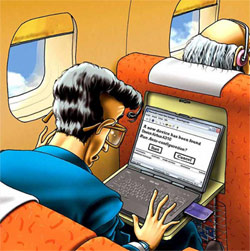 This is the second in our series of articles showing how to deploy a Bluetooth Proximity Detection system with Asterisk@Home. Part I is here. When we’re finished, your system will automatically transfer incoming calls in your home or office to your cellphone or any other phone whenever you leave home base carrying your bluetooth-enabled cellphone or your bluetooth headset. You’ll recall that we recommended the headset approach because cellphones have a nasty habit of putting themselves and their bluetooth adapter to sleep when you’re not on the phone. If bluetooth on the phone is sleeping, we lose our ability to detect your comings and goings so be reasonable and do it our way. Use a bluetooth headset. Once you remove the earpiece, the bluetooth headset fits comfortably in your pocket and isn’t much larger than a flash drive. For our purposes the bluetooth headset will be functioning primarily as an electronic key although there’s no reason you can’t also use it in conjunction with either your bluetooth cellphone, or a softphone connected to your primary Asterisk@Home PBX, or all of the above. The major difference in our approach and some of the other proximity detection systems which (still) are on the drawing boards is cost. Our bluetooth headset “key” costs roughly $30 delivered to your door. Most of the corporate dream systems require a $200 badge (to do the same thing) and then an incredibly expensive server (to do what we’re doing with an old clunker PC). So, yes, open source technology is a very good thing for all of us. And it deserves your financial support. Here’s a link if you’d like to make a contribution in any amount to the Asterisk@Home project. End of sermon.
NOTE: This article has been updated to take advantage of TrixBox, freePBX, and the iPhone. For the current article, click here.
Detect the presence of a Bluetooth device
This example shows how to check for the presence of a mobile phone. The code was based on the article 'Implementing Bluetooth Proximity Detection with Asterisk.#!/usr/bin/ruby #file: whereib.rb deviceid = '00:0E:6D:29:38:EB' devicename = 'Nokia 6600' count = 0 while count < 1 if `hcitool name #{deviceid}`.chomp == devicename puts devicename + ' IN RANGE' puts Time.now else puts devicename + ' OUT OF RANGE' puts Time.now end sleep 7 end__
Sending/Receiving SMS CODE YOU CAN LEARN AND INNOVATE
www.youthsprouts.blogspot.com Sending sms from nokia series 60
import messaging messaging.sms_send(number, text)Sending/Receiving SMS from MIDlets
// Lets send an SMS now.
//get a reference to the appropriate Connection object using an appropriate url
MessageConnection conn = (MessageConnection) Connector.open("sms://:50001");
//generate a new text message
TextMessage tmsg = (TextMessage) conn.newMessage(MessageConnection.TEXT_MESSAGE);
//set the message text and the address
tmsg.setPayloadText(message);
tmsg.setAddress("sms://" + number);
//finally send our message
conn.send();
// Time to receive one.
//get reference to MessageConnection object
MessageConnection conn = (MessageConnection) Connector.open("sms://:50001");
//set message listener
conn.setMessageListener(
new MessageListener() {
   public void notifyIncomingMessage(MessageConnection conn) {
      Message msg = conn.receive();
      //do whatever you want with the message
      if(msg instanceof TextMessage) {
         TextMessage tmsg = (TextMessage) msg;
         System.out.println(tmsg.getPayloadText());
      } else if(msg instanceof BinaryMessage) {
         .....
      } else {
         ......
      }
   }
}
);
Send and receive SMS text messages with Ruby and a GSM/GPRS modem
require 'serialport'
require 'time'

class GSM

SMSC = "+447785016005"  # SMSC for Vodafone UK - change for other networks

def initialize(options = {})
 @port = SerialPort.new(options[:port] || 3, options[:baud] || 38400, options[:bits] || 8, options[:stop] || 1, SerialPort::NONE)
 @debug = options[:debug]
 cmd("AT")
 # Set to text mode
 cmd("AT+CMGF=1")
 # Set SMSC number
 cmd("AT+CSCA=\"#{SMSC}\"")
end

def close
 @port.close
end

def cmd(cmd)
 @port.write(cmd + "\r")
 wait
end

def wait
 buffer = ''
 while IO.select([@port], [], [], 0.25)
   chr = @port.getc.chr;
   print chr if @debug == true
   buffer += chr
 end
 buffer
end

def send_sms(options)
 cmd("AT+CMGS=\"#{options[:number]}\"")
 cmd("#{options[:message][0..140]}#{26.chr}\r\r")
 sleep 3
 wait
 cmd("AT")
end

class SMS
 attr_accessor :id, :sender, :message, :connection
 attr_writer :time

 def initialize(params)
     @id = params[:id]; @sender = params[:sender]; @time = params[:time]; @message = params[:message]; @connection = params[:connection]
 end

 def delete
   @connection.cmd("AT+CMGD=#{@id}")
 end

 def time
   # This MAY need to be changed for non-UK situations, I'm not sure
   # how standardized SMS timestamps are..
   Time.parse(@time.sub(/(\d+)\D+(\d+)\D+(\d+)/, '\2/\3/20\1'))
 end
end

def messages
 sms = cmd("AT+CMGL=\"ALL\"")
 # Ugly, ugly, ugly!
 msgs = sms.scan(/\+CMGL\:\s*?(\d+)\,.*?\,\"(.+?)\"\,.*?\,\"(.+?)\".*?\n(.*)/)
 return nil unless msgs
 msgs.collect!{ |m| GSM::SMS.new(:connection => self, :id => m[0], :sender => m[1], :time => m[2], :message => m[3].chomp) } rescue nil
end
end


destination_number = "+44 someone else"

p = GSM.new(:debug => false)

# Send a text message
p.send_sms(:number => destination_number, :message => "Test at #{Time.now}")

# Read text messages from phone
p.messages.each do |msg|
puts "#{msg.id} - #{msg.time} - #{msg.sender} - #{msg.message}"
# msg.delete
end
Python - SendSMS over BT and AT

import bluetooth

sockfd = bluetooth.BluetoothSocket(bluetooth.RFCOMM)
sockfd.connect(('00:00:00:00:00:00', 1)) # BT Address
sockfd.send('ATZ\r')
sockfd.send('AT+CMGF=1\r')
sockfd.send('AT+CSCA="+393359609600"\r') # Client TIM ITA
sockfd.send('AT+CMGS="+39xxxxxxxxxx"\r') # TO PhoneNumber
sockfd.send('Messaggio da mandare...\n')
sockfd.send(chr(26)) # CTRL+Z
sockfd.close()
Plantronics Voyager 510 USB Bluetooth headset--- for skype
www.youthsprouts.blogspot.com
Photo
Plantronics sent me their Click for Amazon price:
Plantronics Voyager 510 Bluetooth Headset with Multipoint Technology [Retail Packaged]
Buy Now', STICKY, TIMEOUT, 6000);" onmouseout="return nd();">Voyager 510 Bluetooth headset to review. Unlike any other Bluetooth headsets, the Plantronics Voyager 510 USB Bluetooth headset is the first to simultaneously support both VoIP softphones on your PC and your Bluetooth mobile phone simultaneously -- negating the need to deregister/re-register your Bluetooth connection with the other device. Plantronics is able to do this using their exclusive Multipoint Technology.
Measuring 4.0 x 2.5 x 0.8 inches and weighing 5.6 ounces, the Plantronic Voyager 510 headset is pretty lightweight - after awhile you don't even notice it is there. It is slightly heavier and bulkier than the Click for Amazon price:
Motorola HS850 Bluetooth Headset [Bulk Packaged]
Buy Now', STICKY, TIMEOUT, 6000);" onmouseout="return nd();">Motorola HS850 , but I found the Voyager 510-USB much more comfortable on my ear. The Motorola HS850 would often dangle and not stay put.
Many PCs or even laptops don't have built-in Bluetooth, but fortunately, the Voyager 510 USB includes a plug and play Bluetooth USB adapter that works without the need for any software drivers. This enables mobile professionals to engage in one-step hands-free VoIP calling. If you want the ability to perform remote-end answer/hang-up integration with softphones you'll need to install the PerSonoCall application.
 The system integrates with enterprise softphone software from leading companies — including Avaya, Cisco, Nortel, Skype, and others — to offer call notification and remote call answering through the headset. It also is compatible with most popular consumer VoIP services, like AOL, MSN, and Yahoo! although it doesn't feature remote call answer with these yet. I tested the ability to remotely answer incoming Skype calls from the 510-USB and it worked without a hitch. On an incoming Skype call from Greg Galitzine I simply pressed the call control button on the 510-USB and the Skype call was accepted. Beauty, eh?
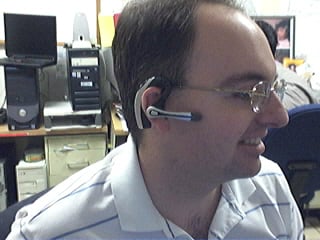 Profile of the Plantronics Voyager 510 USB Bluetooth Headset
The headset's "smart" technology knows which Bluetooth device you are using and allows you to take calls from any device simply by hitting the button. With the optional Plantronics Bluetooth Deskphone Adapter you can even switch between your office phone and your Bluetooth mobile phone. Thus, you won't need to use a dedicated "landline" phone headset.
The 510 headset features a noise-canceling microphone for clearer conversations and the mic boom swivels to position on either ear. The 510 supports adaptive frequency hopping (AFH) which helps avoid interference from WiFi networks. It supports a hefty 6 hours talk time using the built-in Lithium polymer rechargeable battery and up to 100 hours of standby time.
Profile of the Plantronics Voyager 510 USB Bluetooth Headset
The headset's "smart" technology knows which Bluetooth device you are using and allows you to take calls from any device simply by hitting the button. With the optional Plantronics Bluetooth Deskphone Adapter you can even switch between your office phone and your Bluetooth mobile phone. Thus, you won't need to use a dedicated "landline" phone headset.
The 510 headset features a noise-canceling microphone for clearer conversations and the mic boom swivels to position on either ear. The 510 supports adaptive frequency hopping (AFH) which helps avoid interference from WiFi networks. It supports a hefty 6 hours talk time using the built-in Lithium polymer rechargeable battery and up to 100 hours of standby time.
 Front View of the Voyager 510 USB Bluetooth Headset
When you place the headset on the charging base, it automatically turns off the headset and charges it. Fortunately, when you remove the Voyager 510 from the charging base it remembers to turn it back on. Similarly, if you manually shut off the headset (depress power switch for 3s) and then place it on the charger, if you remove the headset from the base, the headset stays off. I wonder if the headset isn't truly "off" when you place the Voyager headset onto the charging base while it is still on? It's probably in a pseudo-sleep mode, but not totally powered off. The difference in charging the battery is probably negligible, so most users will probably keep the headset always turned on even when charging.
Front View of the Voyager 510 USB Bluetooth Headset
When you place the headset on the charging base, it automatically turns off the headset and charges it. Fortunately, when you remove the Voyager 510 from the charging base it remembers to turn it back on. Similarly, if you manually shut off the headset (depress power switch for 3s) and then place it on the charger, if you remove the headset from the base, the headset stays off. I wonder if the headset isn't truly "off" when you place the Voyager headset onto the charging base while it is still on? It's probably in a pseudo-sleep mode, but not totally powered off. The difference in charging the battery is probably negligible, so most users will probably keep the headset always turned on even when charging.
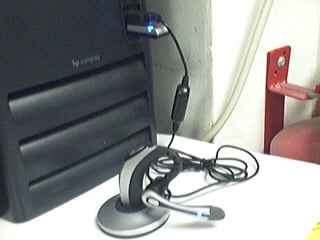 Plantronics USB 510 charging base connected to 1 USB port.
Bluetooth dongle connected to PC's 2nd USB port
Button functionality & testing
I had some minor difficulties with the power on/off switch which is very small and located just in front of the volume buttons, and it requires a very hard press. When the headset is on your ear, making a hard button press took a little getting used to. In any case, there are basically three buttons on the headset. The first button is simply a +/- volume button, which happens to be the largest of the three making it easy to adjust the volume.
The 2nd button on the 510 is the small black button I mentioned which toggles the power button (and mute with a quick depress). The power button requires you hold the button for 3s to toggle the power. Well, they advertise in the manual that it's 3 seconds, but I tested it and it's actually 3s to turn on and just 2-2.5s to turn off. The 3s is a tad long to turn on, but useful I suppose to prevent accidentally turning on or off the headset. Of course, like I said, you have to press the power button pretty hard, so I doubt it would be pressed by accident. It probably has more to do with the time it takes to negotiate a connection with the other Bluetooth devices.
The 3rd button on the Voyager is placed where the boom mic meats the ear piece and it is used to call answer or end the call, as well as toggle between your PC Bluetooth connection and your Bluetooth mobile phone. It is also used to activate voice dialing, redial, and other functions.
To activate last number redial you simply double click the call control button. You will hear a high tone for each key press. When you hear a further tone, the last number has been redialed. In addition, when receiving an incoming call you can press and hold the call control button to reject a call. You will hear a tone. When you hear a second tone, the call has been rejected and you can release the button.
Voice Dialing & Call Transfer to other BT device
You can easily perform voice dialing supported by your mobile phone by pressing and holding the call control button for 2 seconds until you hear a second tone. Then you can speak the name of the person you wish to reach. Switching a call from your mobile phone to the headset is pretty straightforward. You simply briefly press the call control button. Switching a call from the headset back to the phone requires a slighly longer button press until you hear a tone indicating the transfer has been complete. I was able to listen to streaming music on the 510-USB, hear beeps in the headset that an incoming call was coming in, and then press the call control to answer the call.
Features
Plantronics USB 510 charging base connected to 1 USB port.
Bluetooth dongle connected to PC's 2nd USB port
Button functionality & testing
I had some minor difficulties with the power on/off switch which is very small and located just in front of the volume buttons, and it requires a very hard press. When the headset is on your ear, making a hard button press took a little getting used to. In any case, there are basically three buttons on the headset. The first button is simply a +/- volume button, which happens to be the largest of the three making it easy to adjust the volume.
The 2nd button on the 510 is the small black button I mentioned which toggles the power button (and mute with a quick depress). The power button requires you hold the button for 3s to toggle the power. Well, they advertise in the manual that it's 3 seconds, but I tested it and it's actually 3s to turn on and just 2-2.5s to turn off. The 3s is a tad long to turn on, but useful I suppose to prevent accidentally turning on or off the headset. Of course, like I said, you have to press the power button pretty hard, so I doubt it would be pressed by accident. It probably has more to do with the time it takes to negotiate a connection with the other Bluetooth devices.
The 3rd button on the Voyager is placed where the boom mic meats the ear piece and it is used to call answer or end the call, as well as toggle between your PC Bluetooth connection and your Bluetooth mobile phone. It is also used to activate voice dialing, redial, and other functions.
To activate last number redial you simply double click the call control button. You will hear a high tone for each key press. When you hear a further tone, the last number has been redialed. In addition, when receiving an incoming call you can press and hold the call control button to reject a call. You will hear a tone. When you hear a second tone, the call has been rejected and you can release the button.
Voice Dialing & Call Transfer to other BT device
You can easily perform voice dialing supported by your mobile phone by pressing and holding the call control button for 2 seconds until you hear a second tone. Then you can speak the name of the person you wish to reach. Switching a call from your mobile phone to the headset is pretty straightforward. You simply briefly press the call control button. Switching a call from the headset back to the phone requires a slighly longer button press until you hear a tone indicating the transfer has been complete. I was able to listen to streaming music on the 510-USB, hear beeps in the headset that an incoming call was coming in, and then press the call control to answer the call.
Features
- Multipoint Technology allows you to seamlessly switch between two Bluetooth devices
- Noise-canceling microphone for superior sound quality
- Up to 6 hours talk time and up to 100 hours standby time
- One-touch call answer/end, last number redial and voice activated dialing
- Compatible with Bluetooth devices supporting the headset or hands-free profile
- Noise-canceling microphone and wind-reduction technology for brilliant sound both indoors and out;
- Lightweight, foldable design for all-day comfort and easy storage;
- Boom swivels for use on either ear;
- 33-foot roaming distance. feet away from voice-enabled Bluetooth devices
Plantronics Voyager 510 Bluetooth Headset with Multipoint Technology [Retail Packaged]
Buy Now', STICKY, TIMEOUT, 6000);" onmouseout="return nd();">Voyager 510 USB Bluetooth headset is available on Amazon for just $47.99 if you just need the headset to have access to a Bluetooth mobile phone. If you need the optional USB Bluetooth dongle/transmitter for PC-connectivity (VoIP, iTunes, other sound apps) then you can also Click for Amazon price:
Plantronics Voyager 510S Bluetooth Headset System
Buy Now', STICKY, TIMEOUT, 6000);" onmouseout="return nd();">pick it up on Amazon for about $179 (originally $299). Some PC's come with Bluetooth adaptors, or you may already have a USB Bluetooth dongle - though I'm not sure how well Plantronic's multipoint technology works if you use a 3rd party Bluetooth dongle. Best bet is to pay the $179 for both the headset and the Plantronics USB Bluetooth adaptor. __
Sunday, April 13, 2008
Dell vs Apple
www.youthsprouts.blogspot.com y brother has a Dell Inspiron, my sister has an Apple Macbook. The inspiron has a Dell Wireless 1390 or Intel Wireless 3945 card, while the Macbook has AirPort Extreme Wi-Fi 802.11 a/b/g/n. The other night we were all playing an online game, with mixed results. They share a DSL connection to the internet, while I measured their latency over time from my Verizon FIOS:

Looking at the box-plots for my brother, who has the Dell, he is spending about 50% of his time experiencing latencies up to twice as bad as they should be, while my sister is getting decent, consistent Wireless performance. I don’t know if it’s environmental to their home, or something else, but what’s causing such bad performance for my brother? Does Dell just suck that much?
__
Saturday, April 12, 2008
Nokia Predicts 500 Million Mobile Users by 2010
  |
|
Speaking at the Goafest Conclave, D Shivakumar, vice president and managing director of Nokia India, predicted that half the subscribers will be accessing the Internet through mobile phones. In his view, services delivered through mobiles will open a window of opportunity for advertisers in the country. He went on to say that the market will be divided into three sections: the top-end limited to some 50 million customers, the mid-range comprising around 150 million subscribers, and the third tier -- claimed to be unique to India -- dominated by low-cost basic handsets with minimal functionality.
While it may be good for India to have so many mobile phone users by 2010, it may be quite another thing for them to experience better network connectivity and cheaper calling rates by that time.
Micro Technologies Rolls Out ‘Software’ To Locate Stolen NBs.India’s first laptop tracking system
Mumbai based Micro Technologies Ltd has made announcement about the  launching of India’s first laptop tracking system, which will locate stolen laptop computers.
The newly launched software known as “Micro LNTS” (Lost Notebook Tracking System) can be installed on notebook hard drives where it subsequently works in stealth mode.
In case of theft, it permits systems to be tracked as soon as they are connected to the World Wide Wed (WWW). The users can log into their Web-based personal tracking and monitoring page via www.microInts.net in order to trace from where the laptop has been accessed.
Dr. P. Sekhar, chairman and managing director of Micro Technologies, said, “LNTS is just the incidental name. It is also a manageability tool for files and folders as well as a parental control system for tracking the online activities done by children. The system can be used to keep a check on the number of hours children spend on the Internet and what kind of websites they visit.”
The software also provides other management tools including sending out regular emails for notebook activity, hide the documents containing important data, date-wise data storage, login intimation on mobile and email, remotely monitoring of user specified URL/Document, and getting the list of installed software.
But it should be remembered that LNTS is not fool-proof like other software tools. If a thief formats the hard drive of the notebook before connecting to the Internet, the software will be deleted from the system.
The software is available in 3 different models including LNTS- Elite and Premium for individual users, and Micro LNTS-Corporate Micro LNTS. The Elite model is priced at Rs. 600, whereas the Premium costs Rs 1500.
The stock of the company, on Friday (April 11), marked its closure at Rs 277.55, up 1.1% on the Bombay Stock exchange (BSE).
__Friday, April 11, 2008
Samsung SPH-P9000 WiMax Phone Unveiled--- a cool phone
 Samsung today unveiled the SPH-P9000 Deluxe MITs, the latest in mobile convergence device. Introduced at the Mobile WiMax Summit 2006, the SPH-P9000 ushers in the new era of mobile convergence technology, capable of voice and multimedia data communications through Mobile WiMax technology.
The SPH-P9000 is a PDA-based device utilizing Mobile WiMax and CDMA EV-DO connectivity for wireless access to the Internet and simultaneously providing mobile phone connection for voice communication.
With Microsoft Windows XP as the operating system, users will find the contents and applications familiar and easy to use for work and play. Integrating a QWERTY keyboard, the SPH-P9000 offers painless typing and internet surfing, while the MP3 player function, VOD, and camera function provide a quick access to multimedia entertainment.
The 5.0-inch WVGA screen is prepared for movie and document viewing, while the 30 GB hard drive stores music, movies, and documents. All of these unique features are combined into one device that weighs in at a little over one pound. The SPH-P9000 will be launched in Korea first half of 2007.
Samsung SPH-P9000 Specifications
- Standard: Mobile WiMax / CDMA 1x EV-DO
- Camera: 1.3-Megapixel Camera
- Display: 5-inch WVGA LCD
- 1 GHz (Transmeta) CPU
- QWERTY Keyboard
- Bluetooth (Class 1) with BT Messenger
- MiniUSB / 24 pin Connector
- Extended I/O Pack
- 2980 mAh / 7200 mAh Battery
- 30 GB Embedded
- Size: 143 x 92 x 29.7 mm
- Weight: 560 g
__
Samsung today unveiled the SPH-P9000 Deluxe MITs, the latest in mobile convergence device. Introduced at the Mobile WiMax Summit 2006, the SPH-P9000 ushers in the new era of mobile convergence technology, capable of voice and multimedia data communications through Mobile WiMax technology.
The SPH-P9000 is a PDA-based device utilizing Mobile WiMax and CDMA EV-DO connectivity for wireless access to the Internet and simultaneously providing mobile phone connection for voice communication.
With Microsoft Windows XP as the operating system, users will find the contents and applications familiar and easy to use for work and play. Integrating a QWERTY keyboard, the SPH-P9000 offers painless typing and internet surfing, while the MP3 player function, VOD, and camera function provide a quick access to multimedia entertainment.
The 5.0-inch WVGA screen is prepared for movie and document viewing, while the 30 GB hard drive stores music, movies, and documents. All of these unique features are combined into one device that weighs in at a little over one pound. The SPH-P9000 will be launched in Korea first half of 2007.
Samsung SPH-P9000 Specifications
- Standard: Mobile WiMax / CDMA 1x EV-DO
- Camera: 1.3-Megapixel Camera
- Display: 5-inch WVGA LCD
- 1 GHz (Transmeta) CPU
- QWERTY Keyboard
- Bluetooth (Class 1) with BT Messenger
- MiniUSB / 24 pin Connector
- Extended I/O Pack
- 2980 mAh / 7200 mAh Battery
- 30 GB Embedded
- Size: 143 x 92 x 29.7 mm
- Weight: 560 g
__
WiMAX-enabled VoIP phone showcased at Mobile World Congress
www.youthsprouts.blogspot.com


 Ridiculous quantities of 3G handsets weren't the only things showed off at this year's Mobile World Congress -- oh no, NetIndex, Kaga Electronics and Runcom shook up the norm a bit with their WiMAX-enabled portable VoIP phone. Reportedly, the trio joined forces to develop a VoIP handset that utilized a 802.16e module, and aside from "realizing all-IP voice communication," it also sports a web browser and integrated WiFi for times when a plain ole hotspot will do. Sadly, we've no idea where this thing will go after it leaves Barcelona (nor what it looks like), but here's to hoping it makes a commercial debut -- and can decide on a single logo -- in the not-too-distant future.
__
Ridiculous quantities of 3G handsets weren't the only things showed off at this year's Mobile World Congress -- oh no, NetIndex, Kaga Electronics and Runcom shook up the norm a bit with their WiMAX-enabled portable VoIP phone. Reportedly, the trio joined forces to develop a VoIP handset that utilized a 802.16e module, and aside from "realizing all-IP voice communication," it also sports a web browser and integrated WiFi for times when a plain ole hotspot will do. Sadly, we've no idea where this thing will go after it leaves Barcelona (nor what it looks like), but here's to hoping it makes a commercial debut -- and can decide on a single logo -- in the not-too-distant future.
__
Friday, April 04, 2008
HOW VOIP WORKS? AN EASY WAY
1.) Get a good, fast and reliable Internet connection To use VoIP, you need at least broadband Internet connection, sad to say that dial-up will just frustrate you. There are lots of Internet Service Providers (ISP) today who offer high speed Internet connection via broadband (DSL) or dedicated Internet (ISDN) connection.
2.) Make VoIP calls The next step is to decide what type of VoIP calls you would like to use, there are couple of scenarios about this below:
a.) Computer to Computer VoIP call
This is the “basic VoIP connection”, the caller and the called party’s computers must be online, must have headsets attached to the computers’ sound cards. The computers must be connected to the Internet and must be running VoIP software. Most VoIP softwares available today are free and allow you to connect to any computer running the same software. Skype is the best example of this free software. There is no charge for this type of call and calls can be made to anywhere in the world if you are aware of the IP address (other VoIP softwares use phone number) of the computer you would like to call.

b.) Computer to Phone VoIP call
For this type of VoIP connection to work, one party must be online, running VoIP software and has subscribed to a VoIP provider who offers PC to Phone VoIP calls and vice versa while the other party is using a phone that is not connected to the Internet (regular or mobile phone). Let say for example the caller is the one on the computer with VoIP software and the called party is the one who has a traditional phone. The caller dials the number from the VoIP software running in the computer. The call is then routed through the Internet and was received by the VoIP provider, the VoIP provider with an interconnection to Public Switched Telephone Network (PSTN) then routes the VoIP call to the called party’s regular or mobile phone.

c.) Phone to Phone VoIP call
You can make/receive VoIP calls using an ordinary telephone or an IP Phone. If you would like to use an analog phone, you must have an Analog Terminal Adapter (ATA). ATA is a device that allows you to use a regular phone unit to make VoIP calls. An ATA must have a valid IP address and must be connected to the Internet. If you would like to use an IP Phone (sometimes called SIP Phone or VoIP Phone), you don’t need an ATA at all, the IP Phone is connected directly to your Ethernet Hub which is connected to your ISP’s baseband or DSL modem.

d.) Analog or mobile phone to another analog or mobile phone VoIP call
“YES, there is such a VoIP call folks”, you won’t notice it but majority of the telephone companies today are starting to migrate their interconnection to other carriers to VoIP. This is pretty simple, you use your regular analog line to call another analog line, your telephone provider then routes the call over a VoIP interconnection to the destination telephone provider (assuming they have VoIP interconnection) using a special commercial-type VoIP equipment (e.g. Quintum or Cisco). You are actually connected to the called party but you are unaware that the conversation is passing through VoIP channels.

NOTE: This type of VoIP call is for telephone companies only, an SMB with a remote office can also use this to dial a number from the remote corporate PBX using their local corporate PBX to save money from long distance calls.

Post YOUR COMMENTS
__
Networks promise 'accident-free' cars

Embedded sensor networks are designed to replace existing networks that can only share information that has already been captured and stored.
Sensor networks instead take information from several individual nodes - potentially thousands of them in different locations - in real time, and can act on it accordingly.
This means that during a journey, vehicles could monitor each other's speed and position - and therefore dramatically cut the risk of accidents.
"I think that we may, in the future, go beyond just communication to using the network to interact with the environment," Professor PR Kumar of the Convergence Lab at the University of Illinois told BBC World Service's Digital Planet programme.
"For example, cars on a highway may talk to each other and find out each others' speeds. So a sensor in that context could just be the speedometer on a car, which could talk to surrounding cars.
"These cars could then co-operate with each other to avoid accidents and so on."
Changing speed
Most advanced networks currently work on an ad hoc basis - established through links between laptops, for example, which can share information between them.
But embedded sensor networks represent a shift away from computers communicating purely over a network, to sensors which communicate with each other.
And the next stage is an "actuator network" - where computers are able to act on the information they receive from the sensors. This could mean, for example, reducing speed in advance if slower traffic conditions are detected.
 Heathrow's forthcoming driverless pods work using sensors |
"Interaction is a two-way process, so I don't just want to know what speed it is; I want to change the speed.
"This gives rise to sensor-actuated networks, which are deployed over a wireless network. That could be the kind of system we are headed towards."
He said that these systems represent "the convergence of communication, computation, sensing and actuation."
However he conceded that a lot of issues remain to be sorted out before such a network could be put into practice on the roads.
__Monday, March 31, 2008
MICROSOFT TOCHY TABLE, COOL AND REALLY FRIENDLY
www.youthsprouts.blogspot.com
Microsoft has just unveiled a new technology called Microsoft Surface. A Surface computer is able to recognize physical objects from a paintbrush to a cell phone and allows hands-on, direct control of content such as photos, music and maps. Surface turns an ordinary tabletop into a dynamic surface that provides interaction with all forms of digital content through natural gestures, touch and physical objects. But don’t let me spoil all the fun, there is a great Popular Mechanics video embedded below. Have a look, i think you’ll like it. As well as a couple of great promotional videos on Microsoft Surface website.
Saturday, March 29, 2008
1.3 Megapixel Spy Camera Sunglasses

We all remember seeing those incredible ads for x-ray specs in the back of comic books and some of us probably even mailed in the $3 to a PO Box in New Jersey for rush delivery. “Surprise your friends with amazing x-ray vision” the ads would read. Yeah, someone is going to be surprised but it’s not going to be your friends.
These camera sunglasses certainly aren’t x-ray specs, but they do capture 1.3 megapixel still images (at a resolution of 1280×1024
). The included RF remote-control is ideal for easy, stealth-style photo shooting. High-quality lightweight frame material and UV400 polarized flip-up lens. A polymer li-ion rechargeable battery provides a battery life of up to 9 hours (shooting 1 photo/minute). USB 2.0 interface via a standard Mini USB port for data upload and download & re-charging the battery.The sunglasses also allow you to enjoy your music via MP3 playback. Built-in earbuds provide super convenient listen capability and can be hooked out of the way when not in use.
Price: $99.99 __Earn $$ with WidgetBucks


