
 Even before Weixiao Huang received his doctorate from Rensselaer Polytechnic Institute, his new transistor captured the attention of some of the biggest American and Japanese automobile companies. The 2008 graduate's invention could replace one of the most common pieces of technology in the world--the silicon transistor for high-power and high-temperature electronics.
DIRECTLY TO
 |  |  |  |
YOUTHSPROUTS

Today and Tomorrow is Ours
Friday, June 06, 2008
Weixiao Haung and new GAN transistor.
Saturday, April 19, 2008
Building a skyscraper after 9/11
Freedom Tower is to form the centrepiece of the World Trade Center site in New York, which was devastated by the al-Qaeda attacks five years ago.
Due for completion by 2011, the tower will soar 1,776ft (541m) into the sky and incorporate a number of features intended to ensure maximum safety and security.
| THE FREEDOM TOWER  1 High-level air intakes to minimise pollution, and chemical and biological filtering system
2 Central vertical core housing key safety features, including water-resistant lifts, pressurised fire-escape stairs and separate staircase for emergency workers
3 Extra-strong 3ft (1m) concrete casing protecting central core, sprinklers, emergency risers
4 Multi-layered glass curtain wall to protect building from explosions
A parapet at 1,368ft marks the height of the destroyed twin towers |
Safety features include:
Monday, April 14, 2008
Detect the presence of a Bluetooth device
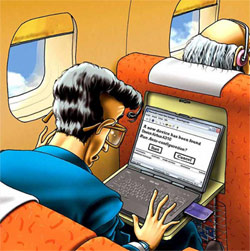 This is the second in our series of articles showing how to deploy a Bluetooth Proximity Detection system with Asterisk@Home. Part I is here. When we’re finished, your system will automatically transfer incoming calls in your home or office to your cellphone or any other phone whenever you leave home base carrying your bluetooth-enabled cellphone or your bluetooth headset. You’ll recall that we recommended the headset approach because cellphones have a nasty habit of putting themselves and their bluetooth adapter to sleep when you’re not on the phone. If bluetooth on the phone is sleeping, we lose our ability to detect your comings and goings so be reasonable and do it our way. Use a bluetooth headset. Once you remove the earpiece, the bluetooth headset fits comfortably in your pocket and isn’t much larger than a flash drive. For our purposes the bluetooth headset will be functioning primarily as an electronic key although there’s no reason you can’t also use it in conjunction with either your bluetooth cellphone, or a softphone connected to your primary Asterisk@Home PBX, or all of the above. The major difference in our approach and some of the other proximity detection systems which (still) are on the drawing boards is cost. Our bluetooth headset “key” costs roughly $30 delivered to your door. Most of the corporate dream systems require a $200 badge (to do the same thing) and then an incredibly expensive server (to do what we’re doing with an old clunker PC). So, yes, open source technology is a very good thing for all of us. And it deserves your financial support. Here’s a link if you’d like to make a contribution in any amount to the Asterisk@Home project. End of sermon.
NOTE: This article has been updated to take advantage of TrixBox, freePBX, and the iPhone. For the current article, click here.
Detect the presence of a Bluetooth device
This example shows how to check for the presence of a mobile phone. The code was based on the article 'Implementing Bluetooth Proximity Detection with Asterisk.#!/usr/bin/ruby #file: whereib.rb deviceid = '00:0E:6D:29:38:EB' devicename = 'Nokia 6600' count = 0 while count < 1 if `hcitool name #{deviceid}`.chomp == devicename puts devicename + ' IN RANGE' puts Time.now else puts devicename + ' OUT OF RANGE' puts Time.now end sleep 7 end__
Saturday, April 12, 2008
Micro Technologies Rolls Out ‘Software’ To Locate Stolen NBs.India’s first laptop tracking system
Mumbai based Micro Technologies Ltd has made announcement about the  launching of India’s first laptop tracking system, which will locate stolen laptop computers.
The newly launched software known as “Micro LNTS” (Lost Notebook Tracking System) can be installed on notebook hard drives where it subsequently works in stealth mode.
In case of theft, it permits systems to be tracked as soon as they are connected to the World Wide Wed (WWW). The users can log into their Web-based personal tracking and monitoring page via www.microInts.net in order to trace from where the laptop has been accessed.
Dr. P. Sekhar, chairman and managing director of Micro Technologies, said, “LNTS is just the incidental name. It is also a manageability tool for files and folders as well as a parental control system for tracking the online activities done by children. The system can be used to keep a check on the number of hours children spend on the Internet and what kind of websites they visit.”
The software also provides other management tools including sending out regular emails for notebook activity, hide the documents containing important data, date-wise data storage, login intimation on mobile and email, remotely monitoring of user specified URL/Document, and getting the list of installed software.
But it should be remembered that LNTS is not fool-proof like other software tools. If a thief formats the hard drive of the notebook before connecting to the Internet, the software will be deleted from the system.
The software is available in 3 different models including LNTS- Elite and Premium for individual users, and Micro LNTS-Corporate Micro LNTS. The Elite model is priced at Rs. 600, whereas the Premium costs Rs 1500.
The stock of the company, on Friday (April 11), marked its closure at Rs 277.55, up 1.1% on the Bombay Stock exchange (BSE).
__Sunday, April 06, 2008
Coffee protects brain?

The easy way to neutralise cholesterol?
Coffee may cut the risk of dementia by blocking the damage cholesterol can inflict on the body, research suggests.
The drink has already been linked to a lower risk of Alzheimer's Disease, and a study by a US team for the Journal of Neuroinflammation may explain why.
A vital barrier between the brain and the main blood supply of rabbits fed a fat-rich diet was protected in those given a caffeine supplement.
UK experts said it was the "best evidence yet" of coffee's benefits.
 |  Caffeine is a safe and readily available drug and its ability to stabilise the blood brain barrier means it could have an important part to play in therapies against neurological disorders Caffeine is a safe and readily available drug and its ability to stabilise the blood brain barrier means it could have an important part to play in therapies against neurological disorders 
Dr Jonathan Geiger
University of North Dakota |
The "blood brain barrier" is a filter which protects the central nervous system from potentially harmful chemicals carried around in the rest of the bloodstream.
Other studies have shown that high levels of cholesterol in the blood can make this barrier "leaky".
Alzheimer's researchers suggest this makes the brain vulnerable to damage which can trigger or contribute to the condition.
The University of North Dakota study used the equivalent to just one daily cup of coffee in their experiments on rabbits.
After 12 weeks of a high-cholesterol diet, the blood brain barrier in those given caffeine was far more intact than in those given no caffeine.
__
Subscribe to:
Comments (Atom)
Earn $$ with WidgetBucks


